
Beyoglu Taksim Pera Tour – Sightseeing Guide
A TOUR OF BEYOGLU / TAKSIM / PERA
An often neglected sightseeing route by tourists is that of modern Beyoglu or Pera district, located in Taksim, which in fact wields a whole number of historical interest points from churches, historical buildings, picturesque arcades, old Ottoman hans, to bazaars and fine restaurants, all easily visitable in one area over a couple of hours, depending on what takes your fancy. See our recommended tours of Pera, Beyoglu & the Golden Horn here.
Beyoglu/Pera in the Past
Pera, meaning ‘opposite shore’ generally referred to the shore opposite the harbor of the Golden Horn, that of Galata in Byzantine times. During Ottoman times, it came to refer to the section of Taksim between the Square and Tunel with all its residing foreigners. The fortified enclave of lower Galata’s Jewish, Italian and French were to become the later inhabitants of Pera. As the Ottomans opened to trading with the West, it soon necessitated rapid outer expansion into presently day Beyoglu, with the main route named as Grand Rue De Pera. Such a diversity of new coming nations, ethnic groups and cultures was inevitably going to have an impact on the cities appearance and lifestyle. The first embassy was constructed by the French in lower Pera, quickly followed by a host of other nations competing in lavishness, offsetting a whole European scene within the larger Oriental one.
In keeping with the Western lifestyle, it remained a realm apart, a minute city of its own, feeding and thriving off its own cultural sphere. It became a stage for exhibiting exclusive fashions, holding glamorous embassy dances and parties.. it was quite possibly one of the most mingled and luxuriant foreign communities in the world. Since the formation of the Turkish Republic in 1923, the Grand Rue the Pera ceased to exist as it was re-named Independence Street, or Istiklal Caddesi. As you walk this grand street, tilt your head and try to envision the building facades in full splendor as they were in the nineteenth century heyday of Pera, the bygone era of fine ladies and elegant gentleman.
Beyoglu Today – Istiklal Caddesi / Grand Rue de Pera
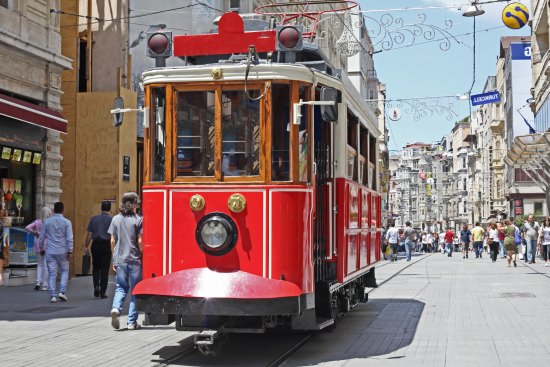
The 1.2 km pedestrianised street leading from Taksim Square down to Tunel is packed with an arbitrary scattering of music and bookstores, movie theaters and cultural centers, cafes, restaurants and bars, commercial banks and offices, shopping outlets and bazaars, consulates and embassies, churches, historical arcades and passageways. Peddlers and street children engage in their prospective businesses of tissue sales, shoeshine and odd bits and pieces, amid clanging tram bells, blasting music shops, and street chatter. It is a public parade for the stylish and high society, and an anonymous lair for the style less, who career in close proximity. Beyoglu nights are for the clubbers and bar-goers, or for those just in search of good food. Weekends see the street swarming with droves of people, which would test anyone’s skills in crowd negotiation. Hence it is advisable to partake in the business of sightseeing on a weekday to avoid any infuriation. The Jazz Music Festival during the summer and Istanbul Film Festivals in the first week of April take over the area, seeing a large influx of musicians and artists and their audiences.
Taksim Square
Setting off from Taksim Square, a central water distribution point of old for all Istanbul, from which it takes its name, water having being taken all the way from Belgrade forest on the Black Sea, is today a noisy and highly congested nexus for traffic and people alike. The Independence Monument stands centrally, revering Ataturk and fellow leaders of the Turkish Independence. Notice the prominent dome of the Aya Triada Kilisesi, Greek Orthodox Church of the Holy Trinity overlooking Taksim square. Access is via the first street off left from Istiklal Caddesi called Meselik Sokak. Enter Istiklal Caddesi and on your right you will pass by the French Embassy, located there since the nineteenth century. It is clearly one of the streets greater landmarks evident by the fact that there is forever a waiting person waiting for someone else to arrive at this 24 hour meeting spot. The renowned Nature & Peace Restaurant, predominantly catering for vegetarians serves wonderfully prepared juicy vegetable and pasta dishes, is located on the left turn-off after Mc Donalds. Continue on the main street and look out for Atlas Pasaji on the left. Entering the passage, one passes through a popular stylish bar on the right, named Sefahathane, where you can enjoy a coffee, cappuccino, or beer at any time of day with Western music and with good service. The bar pre-cedes the Atlas Bazaar, through the entrance at the end, mainly comprising of antiques, carpet shops, ceramic artwork, handicrafts, furniture, calligraphy and jewelry outlets – a miniature grand bazaar in itself and a must-look-at for intrepid shoppers. After a short wander there, head on back down the main street until you come to Cicek Pasaji on the right. Take a stroll through this famous ‘Flower Passage‘, built in the mid nineteenth century, which comes vibrantly alive every evening, resonating under the melodies of live Turkish music. Hosting a number of restaurants nestled cozily all along its cobbled lane, this historical arcade is a popular venue for eaters and drinkers. Should you follow Cicek Pasaji around to the left, it exits into the Balik Pazari or Fish Market, a wild passageway pinned with small fast-food eateries, fresh fish and vegetable market stalls, a sprinkling of other arbitrary shops and thronging with passers-by. Heavily scented by wafting spices and sizzling mussels and other fish, blazing in color and displaying a curious accumulation of foodstuffs, make it altogether an interesting walk. The specialized sweet dessert shops further down the passage on the left turn of the passage are well over 100 years old, offer a great selection of luscious sweets. However keep to the main thoroughfare of the passage and you will notice the small turn off on the right to Nevizade Sokak, there is a whole street spilling over in tables dedicating itself lovingly to the business of the Meyhane, or tavern, in a world of its own. It has got to be one of the most popular Turkish favorites for dining out and is frequented by the young and old, the glib and glitzy alike. Pull up at a table inside or out and order a beverage – all touts are very encouraging and the service is attentive from start to finish. It is traditional that the waiter subsequently approaches with an immense tray laden with tantalizing and mouthwatering preliminary cold starters, or mezes. The idea is to select a couple of dishes that appeal to you which are placed center table and are communally shared. A typical meze table might include white cheese, mashed eggplant, fried vegetables, a herby yogurt dip like sazarki, fried shrimps or mussels, and some melon to be eaten slowly with chunky slices of bread. And this is only for starters!
The favorite accompaniment is Turkish Raki – an alcoholic beverage derived from aniseed and mixed with water which actually compliments the mezes wonderfully. The Turks have refined the whole business of eating into an art itself so that the experience is an culinary explosion of tastes and a titillation to the senses which would put even the French to shame..a scoop of yogurt dip or a steaming buttered shrimp, small sip of Raki, a sip of water, a juicy slice of melon, a sip of Raki. and so this intermittent ritual and pleasure taken in eating and drinking goes on over long hours and under good conversation. Fresh fish or a grilled meat usually fulfill the main course and a complimentary fruit salad is often presented at the finale. You may even have the occasion to be serenaded by passing street musicians at the outdoor settings.
Back to the Fish Market, and whether having stopped off at a tavern for a meal or not, exit at the end. Should you follow the street to the left you will see the high walled garden courtyard and an old building in Italian Renaissance Palazzo style, that has been the British Embassy since 1845. Turn again left at the corner, bearing the highly popular wine bar, Pano, which has been making its very own produce for over 100 years. Veering back in the direction of Istiklal Caddesi, do look out for an easily missable little passage on the left, that is the Avrupa Bazaar, which backs onto the Fish market again. Have a quick look down this pleasant narrow passage housing antique, jewelery and souvenir outlets and glance above at the upper story facades, reminiscent of earlier centuries and lined with a number of posing black statued ladies pre-occupied in their own gesturing motions overlooking the arcade.
Return to the main street you will be directly face to face with the heavy wrought iron gates on the opposite corner that belong to one of Istanbul’s oldest high schools – Galatasaray Lisesi, which offered lectures in French also to children of the affluent society, as this was the lingua-franca of nineteenth century Pera’s media and society. Prior to performing its present day function it also acted as a training ground for the Sultan’s Janissaries, until 1868.
There is an old Turkish bath named Galatasaray Hamami located one street before the high school (coming from Taksim Square) which opened concurrently with the afore mentioned building during the late eighteenth century. If you are not worn out yet an you are still interested in shopping, check out for the small bazaar entrance on the right just as you pass Galata Saray Lisesi, for Aznavur Pasaji . Old lanterns, jewelry, household effects and other junk abound here. There is a café upstairs.
Just a little further also on the right is the entrance to one of the areas oldest churches, the Pansiyon Isodyon, a Greek Orthodox Church, set in its own courtyard, only open on Sundays. Be sure to have a peek in its windows to see some of the old icons, antiques and mosaics.
Back to Istiklal Caddesi. Continue on down and on your left, turn in under one of the looming arches and through the gate of the Church of St.Antoine to a small and quaint shaded cobbled courtyard. Designed in Italian Gothic style dating from 1913 this red bricked affair replicates its ancestral model having been demolished to make way for Istiklal’s tramway. Franciscan monks inhabit the flanking buildings. Despite a rather unspectacular interior and poorly maintained stained glass windows stemming the walls, the large pillars hosting the vaulted ceiling create an expansive sense of spaciousness beneath, and it is worth a quick peek into. Only the occasional sighing of the old wooden benches are to disturb the peacefulness. Upon your exit, take note of the opposite building with mimicking design.
Should you now retrace your steps a little up the street again, you will come across a small passage on the left named Danisman Gecidi, through which you will find a rather pleasant little courtyard and teahouses. Exit through its back archway onto the street beyond, notice the little tea, poker and backgammon parlor on the right filled day and night with gambling elderly men. It is only one of many in Beyoglu backstreets. Cross the street to the promenade and catch a view of over the rather jumbled poorer suburbs cascading from the hilltops and sprawling towards the outer city limits, as far as the eye can see.
Just in front of you will be the famous Pera Palace Hotel, built to accommodate the disembarking passengers of the famed Orient Express train, linking Paris and Constantinople. A grandiose testament to its prestigious status with an air of antiquity stands the tall green Pera Palace Hotel, overlooking the bountiful Golden Horn. Emanating Victorian style typical of the period, it was erected in 1892 by Georges Nackelmackers. For a dip into its Oriental flavored past, be sure to step inside for a quick walk around. The raw presence of luxurious past residing here is striking.
Richly carpeted and high ceilings, decked in antique furniture, original and antique accessories are preserved on display as they were, contributing to the nostalgia and rendering it comparable to a museum rather than a hotel. Throughout its dynamic history it has played host to many esteemed and affluent guests encompassing the glamorous, the Royal, the politically-minded, the famous, and even the questionable – from kings and queens to prime ministers, ambassadors, international spies, artists, actors, novelists and poets.
Agatha Christie, the famous murder mystery novelist notable for her bestseller Murder on the Orient Express, is said to have stayed here and wrote much in the hotels own café, now a Patisserie. Other esteemed guests over the years, to name but a few, include Mustafa Kemal Ataturk, Jacqueline Kennedy Onasis, Julio Iglesias, Greta Garbo, Edward VIII (former King of England).. Just beside the hotel is the US Embassy occupying an attractive marble palace since 1882. Originally they had rented the building but purchased it 2 decades later along with the neighboring building for a library and cultural center.
Standing at the front entrance of Pera Palace, cross the road and take the first turn off left onto Asmali Mescit Sokak, follow it straight ahead and take the second right turn off and you will find yourself in the midst of a really magnificent and picturesque little winding narrow cobbled street, crisscrossed in dangling green vines and ivies dashing against colorfully washed walls of delightful old residences. A small courtyard on its way with wooden tables offer teas and coffees. Follow it to the end and you will step in through the entrance gates of Kahve, a wonderful stop-off for a coffee, or indeed lunch, in cool and artistic outdoor environment, having wandered all this way through the jumbled layers of Beyoglu’s past on tender feet. It is an arty little street arcade in the impressive turn of the century style just opposite the Tunel building. Access is via a large gate; step down into its shaded lane way, which houses some fashionably trendy little coffeehouses set against a backdrop of wall paintings and much leafy greenery sprouting from their pots. There is also a sprinkling of antique and art shops here.
After a rest-stop there, exit the other gate at the end and you will enter Tunel Square. The large building directly opposite is the entrance to the worlds second oldest underground metro service, fondly named Tunel, and the first and shortest one in Istanbul, built in 1875 by the French. It links the steep hill between lower Karakoy and upper Beyoglu. There are still a few remaining sights of interest up on the last section of Istiklal Caddesi, so from Tunel Square walk around to the left and re-enter the main street. There is one of the area’s popular restaurants for fine dining at the Four Seasons Restaurant. Although located in an apparently shabby building, its delicious finely served Turkish and international cuisine and comfortable interior make up for it.
Just on your right on the farther corner is the nineteenth century old Swedish Embassy, graced by a small entrance park with beautiful blooming and budding garden. Now glance immediately to your left opposite the Embassy a bit further on, there is a large peeling ovular building with immense vertical pillars clinging to its facade, quite unusual in its appearance alone, an old Ottoman Han. Inside is the decaying grassy courtyard of this old stop-off point, presumably a bit more colorful and lively in its heyday, but a blissful little nook of tranquility from the bustling street all the same, where you can take the weight off your feet on an old bench and enjoy a tea served by the little shop by the entrance.
Pass further up the street again and the next embassy on the right is the Russian Embassy, a picturesque pink building in Italianate style set behind its also rather imposing gates, also built by the Fossati brothers. Further on a little and the large gates on the right with ascending flight of steps will take you into one of Beyoglu’s most pleasant and beautiful churches, St. Mary Draperis Church, built in 1678. Although not much to look out from its exterior, the inside is surprisingly warm and modernly decorated, very unlike an old church, with gentle pastel colors and beautiful stained glass windows. Don’t miss this little gem. Slightly further on, located off Postacilar Sokak on your right also, is a downward slope which leads to a number of interesting buildings. Going down this street you will pass the Union Church of Istanbul on the left firstly, then a sharp right turn brings you to the face with the doors of a little Spanish Church.
You can decide from this point whether you would like to follow the vicious ascent down the cobbled street on the left (as you will have to return that way) named Tomtom Kaptan Sokak, actually another highly picturesque little lane, pre-ceding the Palazzo Di Venezia, or Italian Consulate, the longest original survivor over centuries of destructive fires in Beyoglu, and the second foreign nation to lay roots in Beyoglu. Just opposite you can take a glimpse in through the gates of the Maison De France, formerly the French Embassy and indeed the very first one to lay it foundations in Pera and lead its subsequent development. Its grounds also house the very old Chapel of St.Louis. Now you must head back up the way you came to the main street again. Continuing up again there is the Dutch Embassy on the right, currently under restoration set back from the street, built in 1855 by the Swiss Fossati brothers. That finishes the main sights of Beyoglu and Pera, and you should now re-double your steps back down to Tunel Square and towards the old quarter of Galata to see the two final interest points.
Going out of Tunel Square, take the narrow street proceeding downhill to the left of Tunel, and just on the left hand side is the entrance to the The Galata Mevlevihane, or Museum of Divine Literature, a formerly active dervish monastery and the first of its kind in Istanbul, where the seven centuries old whirling ritual is still held on the last Sunday of each month to preserve the tradition. An octagonal hall with viewing gallery is the setting for the 2 hour Sema or ceremony. The first hour is led solely by the musical group through a variety of uplifting choral harmonies, lilting melodies and passionate percussion, with particular emphasis on the reed flute accompaniment. The second half sees the solemn entrance of about 15 male and female dervishes clad in black gowns and capped in the unmistakable elongated conical headdress during a deafening silence. Following a short meditative time, the mevlanis or dervishes de-gown to reveal their colorful flowing skirts underneath, and the ritualistic walking involving a series of 3 revolutions about the hall follows. Then the real action begins, as each mevlani in turn starts to spin off, whirling and revolving around the hall until they are all in a state of unison with eachother. At the onset to the whirl, the hands are held crosswise against the breast at first but successively move up and outwards, the right hand facing the sky symbolizing prayer and the left tuned down, to symbolize a correlation with the earth.
The Sema encompasses 4 states or whirlings which represent the transition from Gods unknowing servant to one with acquired knowledge and perfection, having achieved this through acquisition of God’s love and truth and the casting off of oneself, thus enabling a spiritual communion with God (nirvana). The bewildering spectacle of endlessly flailing arms and legs and colorful flowing skirts revolving at tremendous speeds, the mevlanis eyes closed and head bent whirling in unison with the music and in their own communion with God, is truly inspiring and would even make it worthy of changing your holiday dates. Be sure to check out the tombstones in the adjacent small graveyard, each stone capped in the headdress denoting the rank of the deceased.
Head back onto the street and proceed downwards, past the small musical and repair shops, whose shady side-alleys supply some of the cities most infamous brothels by night, but perfectly pleasant during the day, and you will arrive to the famous Galata Tower.
Galata Tower & Galata Quarter Watchtower of the Genovese fortifications dating from 1349, Galata Tower is the only surviving remnant of that colony today and stands an obvious landmark gracing the sky, rising out of present day Beyoglu, overlooking the Golden Horn and across to the Asian shores. The surrounding quarter nurtured a whole diversity of European ethnic minorities which flourished there in the nineteenth century, among them Armenians, Venetians, Jews, Greeks.and it was from this ever expanding mingled foreign quarter that Pera blossomed and bloomed to its European-ness. This lone foreign colony, virtually on the doorstep of the Golden Horn, was warily regarded by those inhabitants and hence Galata was denoted as ‘Pera‘, derived from a Greek word meaning ‘opposite shore’. The concept of that mentality is laughable today when it is the expansive shores of Europe and Asia that are the real opposite shores of today.
An interesting tale and seemingly not urban myth associated with the Galata Tower tells of how one enthusiastic inventor by name of Hazerfan Ahmet Celebi, clipped two homemade wings to himself in the sixteenth century and leapt off the upper tower environs, successfully gliding all the way across the Bosphorus to the town of Uskudar unscathed, and rendering it one of the first flights.
Today it hosts a restaurant and nightclubs but be sure to take a ride up in the towers modern lift and venture outdoors to the panoramic balcony. from which there are breathtaking views over the Golden Horn, Marmara Sea, Princes Islands, the Bosphorus and the brightly colored tiles of Galata’s own residences. And what a magnificent viewpoint to finish the tour, particularly at sunset – still on a high, all of Istanbul gloriously spread at your feet, in gold!