
Old City Tour, Istanbul, Turkey
A TOUR OF THE OLD CITY, SULTANAHMET
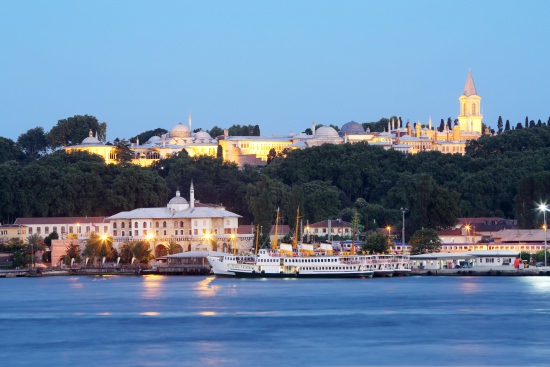
The world renowned cities of Byzantium, Constantinople and Istanbul, in total spanning almost 2500 years, have steeped the Old City area of Sultanahmet in Byzantine and Ottoman-ness, eminent from the marvelous palaces, churches and cisterns, mosques and baths. The main attractions are all within easy walking distance and cover the Haghia Sophia Church, Topkapi Palace, Blue Mosque, Basilica Cistern and Hippodrome. Below is a guide of interesting history and legend associated with them.
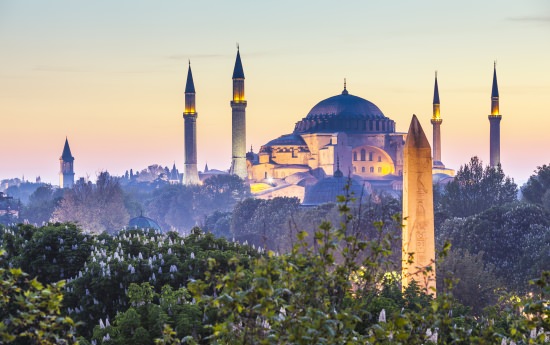
Saint Sophia
Credited as the greatest church in Christendom for almost 1000 years under the Byzantines is the magnificent Saint Sophia Church, whose like had never been realized before and for a long time after, arising from its immense magnitude and soaring dome apparently lacking in any visible support. ‘Saint Sophia’ derived from the Greek language meaning the ‘Church of Divine Wisdom’. The predecessors to its location were also Byzantine churches. One didn’t last long after a fire embraced it, and the second was subsequently torched during an uprising in the nearby Hippodrome. So it was in the sixth century that the Byzantine Emperor Justinian commissioned today’s Saint Sophia, resolved upon size being of utter importance. He had the architects Arthemis of Tralles and Isidarus of Miletus along with 10,000 laborers and 100 stonemasons build the huge edifice in 6 years.
It was the Emperor’s desire that only the richest materials should be used in construction and hence, the church was decorated over a period of 26 years, with precious gold and silver and beautiful marble, taken from as far away as Egypt, Greece and Africa. Hollow bricks from Rhodes were ingeniously used to construct the dome, a boldly unprecedented move which fortunately proved a success. In face of this completed wonder, many stunned faces and gaping mouths greeted the church 1500 years ago, and even Justinian himself couldn’t contain his surprise and elation, shouting that he had surpassed even the great Soloman himself.
An interesting legend arises at this point. A popular tale relates how it was during construction that an angel from God arrived as a protective force for the church, appearing to the architect’s son. If the boy would call the laborers back from the lunch to continue work, the angel said it would guard over the tools while he was doing so. Having heard his son’s report, the architect cleverly forbade his son’s return, forcing the angel to remain a guardian to the site for all time.
It was the churches bright nighttime illumination by thousands of candles that led its visibility comparable to a landmark lighthouse for seamen in Byzantine times. None of Justinian’s interior mosaics have survived as they were destroyed during the iconoclastic period that darkened the eighth century.
Desecration of the church was subsequently endured with the arrival of the Latin Crusaders in 1204, who pillaged all the gold, silver and holy relics, destroyed the altar and had a common harlot dance on Coronation Square, or Emperor’s throne, which people had then believed to be the center of the world.
When Mehmet the Conqueror was to arrive nearly 2 and a half centuries later marking the beginning of the Ottoman Empire, he was to find the sacred church still in ruin and the entrance door lain on the ground. Despite having mounted a fierce siege on the city, the destruction around him made him weep. He immediately converted the magnificent building into a mosque, adding a wooden minaret and sprinkled earth on his turban as a token of his humbleness before God, upon his entrance. Three further minarets were later added by succeeding Sultans. Mosaics dating since the iconoclasts were whitewashed over, and icons faces were covered under the laws of Islam. In 1935, Ataturk had it opened as a museum and the old mosaics uncovered.
In your visit to the ground floor, pay attention to the Sultan’s raised loge, a safehaven where he came to pray unseen via the Imperial entrance following the murder of a previous Sultan in the lower part. Also there are the beautiful veined columns to see. Have a look at the famous ‘weeping column’ where the protectorate angel is supposed to be. Other myths associated with the column say that if your finger emerges moist from the hole there, a wish can be granted. Justinian allegedly leant his head here and cured a headache. Others say the Angel Gabriel put his finger here first and turned the whole position of Saint Sophia slightly to the right, so that it faced Mecca. Miracles and tales never cease! In the upper galleries, which were reserved for women and the high society, there are some of the most wonderful mosaics on view. Also look out for the two marble cut stone gates on the way, reported to represent heaven and hell.
To learn more and discover the Old City in person, you can book an Istanbul City Tour here.
Sogukcesme Sokak
Upon your exit from Saint Sophia, walk around it to your right and follow the tram-line down as far as the entrance to Gulhane Park. Should you turn right, you will be able to walk up to Topkapi Palace via one of the old cities most pleasant and picturesque streets, named Soguk Cesme Sokak, or Street of the Cool Fountain. This little cobbled streets clambers up between the walls of the Palace and the back of the Saint Sophia museum, with blooming flowers and plants along its way. At the very top of the street lies a small fountain from which it takes its name, atop an old Byzantine cistern. Here also is the Sarnic Restaurant serving Turkish cuisine, which occupies part of the old underground cistern itself, a beautiful and atmospheric setting for a meal. Pressed against the palace walls are some beautifully restored typical Ottoman wooden houses, now the famous Aya Sophia Pensiyonlari. Each house is decorated in different colors and with typical nineteenth century decor. There is also the Ataturk Library here. Just as you exit from the top of this little street, note the marble Imperial Ottoman entrance at the corner of Aya Sophia, from where the Sultans could enter directly from the Palace to their loge.
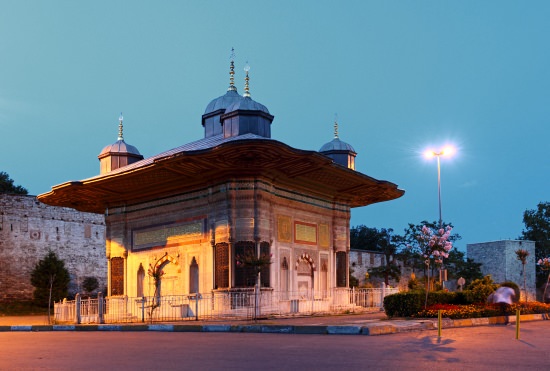
Fountain of Ahmet III
Just in front of the Palace Imperial Gate is the beautiful Fountain of Ahmet III, built by this Sultan in 1728.
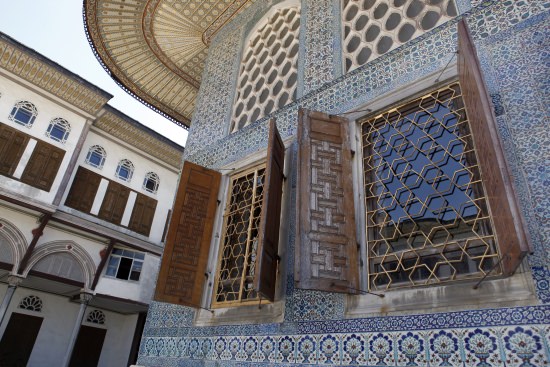
Topkapi Palace
Mehmet the Conqueror left his Old Palace at Beyazit to move into newly built Topkapi in 1465. Home to 26 Ottoman Sultans for almost 300 years before they choose to move to European style palaces like Dolmabahce, each Sultan added his own building which has added to the confused layout. Four main courts and a harem contained over 4000 residents in it heyday.
Court 1
Enter through the first Imperial Gate to the Court of the Janissaries, where the guards hung around and where much public trade and services went on, even executions held. On the right hand side were stables where over 1000 horses were kept in the high-point of the Empire. On the left is the Byzantine Haghia Eirene Church, as old as Aya Sophia and never converted to a mosque, but used as an armory. Entry is by appointment only, or when special concerts are held.
Court 2
Just before you enter under the medieval style Middle Greeting Gate, imagine that this was where severed heads where displayed, and note the executioners washing fountain nearby. The gate was designed by Hungarian architects following Suleyman the Magnificent’s campaign there and the towers often imprisoned undesirable guests.
This courtyard was the business area of the palace, and effectively the parliament or place where the Imperial Council met to make the Empire’s decisions. The 2 chambers of the Divan Council are on the left hand side, under the ‘eye of the Sultan’ – a metal grid in the wall from which he would oversee the proceedings.
It was also the court for receiving foreign ambassadors, holding ceremonies and paying Janissaries. In those days it would have had plenty of exotic animals such as gazelles and peacocks prancing around many fountains. If the Sultan was in the area, complete silence had to be maintained, which led to the development of a special sign language within the palace. During ceremonies, lions and tigers on chains, and lines of a thousand silent Janissaries were common, especially to intimidate foreign visitors. In the central path of the court, one can see the remains of an old Byzantine cistern built over by the palace. Also on the left, were the elephant stables and the entrance to the infamous Harem, which means ‘forbidden’, being so to men.
On the right are 10 palace kitchens, each serving a different class of the palace with over 1000 cooks. Two kitchens were devoted entirely to the Sultan – one for his meals, and one for desserts and drinks. Today it houses an Ottoman glass and silverware exhibition.
Court 3
Entering under the Gate of Felicity brings us to the Sultans’ private domain. Just beyond the gate is the Audience Chamber where the Sultan received the decision of the Divan Council or visits from foreign ambassadors. A running water fountain was placed inside to prevent any eavesdropping. Foreigners conversed with the Sultan via the Grand Vizier who sometimes knew their language, but were obliged to prostrate in front of the Sultans place and kiss his skirt, arms forcibly held by 2 deaf mutes. Directly behind is Ahmed’s Library, which once contained over 1000 Arabic Scripts, now distributed about Istanbul’s museums. This court also held the white eunuch’s quarters, and a palace school for Christian slaves to be educated as future Janissaries.
On the right are 4 chambers of the Treasury which today exhibit the old garments of the Sultans and the revolution to modern fashions in 1826, and a selection of the rich jewels and treasures received as gifts to the palace. Particularly notable are the Topkapi dagger, a present to Kadir Shah, who was assassinated before he could receive it. Also there is the famous Spoonmaker’s Diamond, known as such due to a beggar finding a large uncut stone in a rubbish dump and trading it for 3 spoons to a jeweler.
At the left corner of this court is the Holy Relics rooms, with distinguishing Iznik tiles marking the entrance. After Selim II went into Egypt in 1517, he took the Caliphate back to the Ottoman Empire with him, as well as a number of sacred items of plunder. These include the tooth, hair and footprint of the Prophet Mohammed.
Court 4
On the left past a marble fountain, set back against the far wall is the circumcision room, decorated in Iznik tiles, built by Ibrahim the Mad, who in his paranoia drowned 280 women from the Harem in the Bosphorus. He also built the little bronze canopy that overlooks the sea nearby, called the Itfariye Kiosk, used to break the fast of Ramazan. There are 2 other beautifully decorated kiosks used for conversation and entertainment, called the Revan and Baghdad Kiosks.
On the lower level to the right of these was were the famous tulip gardens and parties were held. In fact Suleyman the Magnificent was quite obsessed with the flower and used its form in many subsequent palace designs. There is also a physicians rooms which had a secondary duty of providing beauty treatments and perfumes for the ladies of the Harem. Lastly on the far right, is the Mecidiye Kiosk, housing a restaurant, but standing alongside it gives way to panoramic spectacular views of the Marmara Sea and the Bosphorus.
The Harem
Entrance is via the second courtyard next to the Divan chambers. This ‘forbidden to men’ zone is where the enslaved women resided, acting as either concubines to the Sultan, or ladies in waiting to the Sultan’s mother (Valide Sultan who ruled the Harem), or to other women of the harem, depending on their position. Favorites were usually taken on in the Valide Sultan’s service to introduce to her son. Much struggle and conspiracy went on among the women to have their son placed in the line of succession. Most of these women had been bought at the slave market, captured in war, or received as gifts to the Sultans, who particularly favored the Circassian beauties of Russia. Upon arrival to the Palace, they would immediately be schooled in the art of grace, education, Islam and Turkish. They were granted some days off to visit around Istanbul as well however, although they would be covered in their rich carriages, a mystery to the public. African and Egyptian eunuchs served the women as well as guarding this private zone. There are over 400 rooms and before moving to European palaces along the Bosphorus, the number of women here had soared to almost 800!
In former years, the sons of the Sultan had fought bitterly to the death with each other to assume the throne as the next heir. Sultan Ahmet altered this when he came to power, causing the foundation of ‘The ‘Cage’ – a place where the eldest son having risen to the throne would incarcerate the younger princes to the pleasures of the harem, until such time as they may need to rise to succession. They were given a certain number of sterilized concubines for their entertainment, and deaf mutes for their service. This proved to be part of the recipe for the downfall of the Ottoman Empire as future Sultans emerging from the Cage were often insane and unfit to rule over state affairs, having no knowledge of such matters. In this absence, Grand Viziers began to play a much more vital role in this area. Only much later on was a new code adopted whereby the next eldest brother would become the successive Sultan. See our recommended Old City Tours in Istanbul including Topkapi Palace tours here.
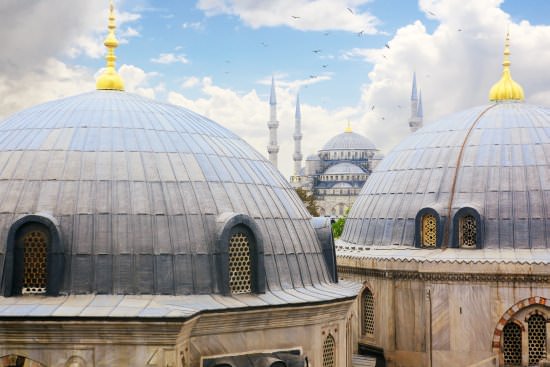
Blue Mosque / Sultanahmet Camii
At the tender age of 19, a young Sultan dug for a whole day at the site of the new mosque, until he became tired. Thus it was that Sultan Ahmet I opened the work, engaging a student of the great architect Sinan, Mehmet Aaga, in an Ottoman attempt to rival the greatness of the Aya Sophia just opposite. It had taken quite a time to find a flat space large enough and this site of ancient Byzantine Palaces was agreed to be the most suitable. Ten years of work led to its completion, a mass granite structure sprouting 6 delicate minarets. Initially this incited serious debate and criticism as it posed the problem of being in direct competition with the also 6-minaretted mosque in sacred Mecca. However, the young Sultan quickly resolved this by financing the construction of a seventh mosque there. It is interesting that he came to power at the age of 16, ruled the Empire for 16 years, gave his name to the district and was the sixteenth Sultan. This is reflected by the total of 16 balconies on the minarets.
Its popular name, ‘Blue Mosque’, is generated from its interior decor of over 21,000 Iznik tiles in the upper galleries, which overall create a bluish effect. Over 260 windows stem the walls of this immense space. It couldn’t hope to equal the Byzantine feats achieved in the Aya Sophia however, evident by the huge elephant type pillars which underpin the dome. The architect hadn’t calculated to have them there at all, but towards the mosque’s completion he realized that the dome wouldn’t hold. Silk carpets, crystal chandeliers and overhead arabesque calligraphy on the walls and arches complete its decor.
On a winter’s evening, particularly when nestled beneath a gentle blanket of snow, the spotlighted domes and minarets of the Blue Mosque are a truly splendid sight to behold, magically elegant, and out of this world.
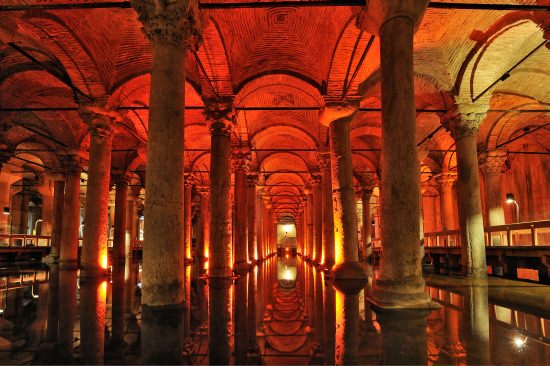
Basilica Cistern / Yerebatan Sarayi
The largest of many Byzantine water storage systems in the city, the Basilica Cistern, supplied the palace and immediate suburbs. It was filled via rainwater and aqueducts from the Belgrade forest 20 km away. For a city so much besieged, it played a major role in maintaining its survival.
It is Emperor Justinian’s sixth century effort that exists today, having absorbed the smaller fourth century Byzantine predecessor into its core. The mix-mash of over 336 columns suggested that they were recycled or pillaged from ruins elsewhere, as evident by the long-time submerged beautiful Medusa snake heads at the end of the cistern, and the tree-trunk/tear effect column with carvings of that effect. The two medusa snake heads were directed to face eachother in the belief that the bad luck associated with her myth would reverse in the face of good luck.
With the arrival of the Ottomans to Istanbul, its function became extinct for 2 reasons. First of all, they were unaware of its very existence for a hundred years, until it was noticed that some people were selling sweet fresh-water fish in close vicinity, and from where could they have obtained them? Of course the fish had streamed into the cistern from the Black Sea via the aqueducts and ended up inside, multiplying there. Upon discovery, the Ottomans used it for watering the gardens of their palaces, as Islam forbade drinking anything other than pure running water.
Later it became a source for dumping rubbish and even corpses and it wasn’t until 1987 that the whole interior was cleaned out, and wooden platforms were put to walk around it for the first time.
Entering, one beholds a beautifully eerie and mysterious spectacle of this world of stone, illuminated columns and beautiful arches all throwing their reflection to you on the rippling water, splashing with plump Carp, and resonating with background classical music. Watch for the green-algaed walls to measure the previous volume of water held there, and be sure to follow the tradition of make-a-wish and throw-a-coin in the shallow water. It is a place of unmatched ambiance and strangeness, and a wonderful spot to enjoy a coffee in the little café with orchestral platform, where concerts are often held.
Cagaloglu Hamami
This is one of the oldest baths in Istanbul where you can still enjoy the traditional bathing experience from being washed, lathered, scrubbed to massaged, whilst lying on a heated marble platform. Now, cross back over towards the park near Blue Mosque to visit the remaining relics of the Hippodrome.
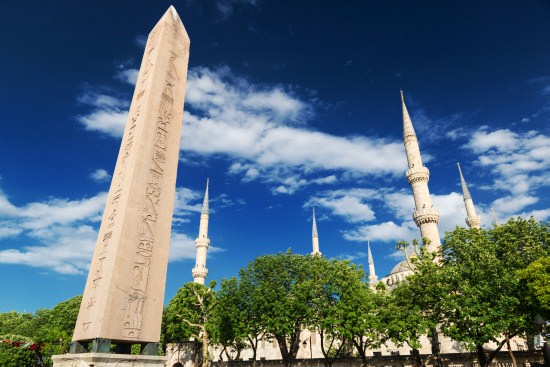
The Hippodrome
This park alongside Aya Sophia and Blue Mosque used to be the venue for sporting events, ceremonies, celebrations and even uprisings. The fourth century arena had a race track where chariot and horse races, javelin throwing and gladiator duels-to-the-death took place under the eyes of the Byzantine Emperor and his subjects, up to 100,000. The winner was presented with gold or had his statue erected on the central spina, or platform, of which there were about 25.
A number of barbaric historical events arose here. The first was in the sixth century when Emperor Justinian raised local taxes. A huge riot resulted until it was quashed with the massacre of 35,000 citizens here. The second misfortune hit with the arrival of the Latin Crusaders in 1204. Having laid siege to the city, they subsequently pillaged all the statues and works of art from the Hippodrome and destroyed it. Thirdly, in 1826, after the Sultan’s Janissary Corps had become wildly corrupt and were running riot across the city, they were finally surrounded in the Hippodrome by his new Asian troops and slaughtered.
Three monuments adorned the spina which still remain today. The Egyptian Obelisk of Theodesius, over 3500 years old, was brought here from Egypt in the fourth century by ship, during which time two thirds of the monument was lost. A marble engraved base was added by the Byzantines depicting the Emperor at various chariot races and celebrations.
There is also the Serpentine Column from the fifth century BC, initially erected in the Temple of Apollo at Delphi after the Greeks defeated the Persians. Their captives’ shields were melted down and resculpted into a monument of 3 spiraling and intertwining serpents (symbolizing health) with projecting heads, which carried a gold platform and vase. The Crusaders soon made fast work of the gold ornaments. When Mehmet the Conqueror arrived almost 250 years later, he decapitated one serpent head with his sword to signal his new power over the city.
Nearby is the Column of Constantine from the sixth century. Holes in its limestone surface indicate there had been a previous coating of bronze, engraved with Greek verses but little is known about it today as it is long since pillaged by the Crusaders.
One more monument that marks the Hippodrome is the German Fountain of Wilheim II, a nineteenth century gift to the city following his visit.
Choose from a range of private guided Istanbul City Tours here and don’t miss any of the historical sights.