
Turkish Drinks from Raki to Boza
TURKISH DRINKS & BEVERAGES
Volumes have been written about Turkish drinks, in particular, Turkish Coffee; its history, significance in social life and the ambiance of the ubiquitous coffee houses. Without some understanding of its background, it is easy to be disappointed by the tiny brew with the annoying grounds, which an uninitiated traveler (like Mark Twain) may accidentally end up chewing. A few words of caution will have to suffice for the purposes of this brief primer. First, the grounds are not to be swallowed; so, sip the coffee gingerly. Secondly, don’t expect a caffeine surge with one shot of Turkish coffee, it is not “strong”, just thick. Third, remember that it is the setting and the company that matters – the coffee is just an excuse for the occasion…
On the other hand, Turkish Tea is the main source of caffeine for Turks. It is prepared in a special way, brewed over boiling water and served in small, delicate, clear, tulip-shaped glasses to show off the deep red color, sometimes called ‘tavşan kanı’ (or rabbit’s blood, the sought-after brew color). The small glasses also keep the tea hot and so it is that quite a few cups are easily enjoyed in a row this way. Tea drinking is such an essential part of a working day, that any disruption of the constant supply of fresh tea is a sure way to sacrifice productivity. The freshly made leaf-tea is a must at a traditional Turkish breakfast, and at lunch you can still find many traditional restaurants offering a complimentary cup of tea afterwards.
Tea even has its own stories and myths in Turkish culture. Once upon a time, so the story goes, a lion escaped from the Ankara Zoo and took up residence in the basement of an office building. It began devouring public servants and executives. It had even eaten a few ministers of state and nobody had seemed to take any notice. That is, until the lion ate the “tea-man”, the person responsible for the supply of fresh tea – Immediately a group was formed and the lion was caught!
A park without tea and coffee is inconceivable in Turkey. Thus, every spot with a view has a teahouse or tea-garden. These places may be under a simple tree looking into the village or town square, on top of hills with majestic views of a valley or the sea, by the harbour, in the market, on a road-side with a scenic overview or in the woods. Among the typical tea-gardens in Istanbul are: the Emirgan on the European side, Camlica on the Anatolian side of the Bosphorus, the famous Pierre Loti cafe, and the tea-garden in Uskudar. But the traditional teahouses are beginning to disappear from the more tourist-oriented seaside locations, in favour of “pubs” and “Biergarden”. Among the beverages worth mentioning are excellent bottled fruit juices.
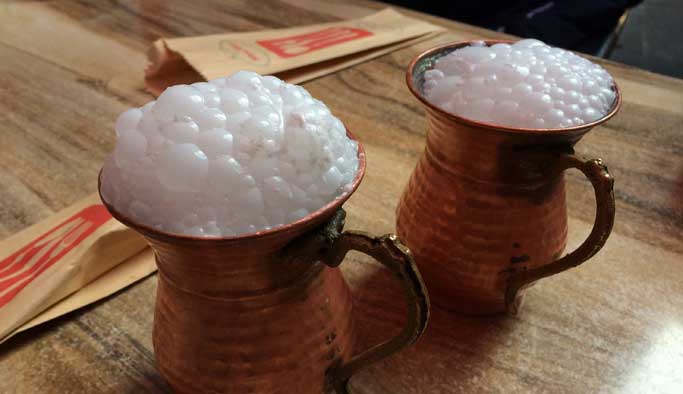
However, perhaps the most interesting drink is “Boza“, traditionally sold in neighborhood streets by mobile vendors on a winter night. This is a thick, fermentated drink made of wheat berries, enjoyed with a dash of cinnamon and handful of roasted chick-peas. Boza can also be found year round at certain cafes or dessert shops. Finally, “sahlep” is a hot drink made with milk and sahlep powder. It is a delicious remedy for sore throats.
It wouldn’t be Turkey without a mention of Rakı, a strong alcoholic beverage somewhat similar to Greek Ouzo, flavored from aniseed. Mixed with water it turns milky in color, thereby getting a nickname called “Aslan Sutu” or Lion’s Milk. It is served in twin tall narrow glasses with a couple of ice-cubes in the Rakı glass and just water and ice in the other glass to balance it out. Rakı is traditionally drank with Turkish mezes at the Meyhane style of restaurants.
Learn more about Turkish Cuisine:
- Ottoman Cuisine
- Turkish Mezes
- Baklava – Turkish Sweets
- Seafood Dishes
- Turkish Drinks
- Vegetables & Vegetarian Dishes
Book Private City Tours in Istanbul with official tour guides.