
Istanbul Facts
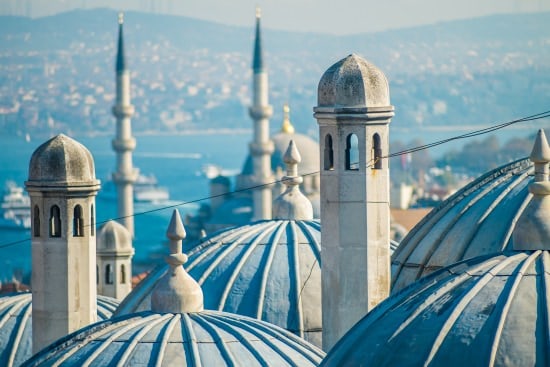
Istanbul is a cosmopolitan city built on two continents. The most recent population census shows that it has a population of about 12 million people, from which almost 65% are inhabitants of the Asian side. Fulfilling the residential role of the city, it doesn’t present a lot to see historically.
In contrast, the European side is the commercial and cultural center, further divided into two districts (the Old City and the modern downtown) by a narrow channel of water called ‘the Golden Horn’. Below you will find some helpful details to make your stay easier when you are in Istanbul.
Arrival
Most countries’ citizens require a visa to enter Turkey. For some countries this visa can be supplied directly upon arrival at the airport, for others it is advisable to pre-arrange it at a Turkish Embassy in the home country. Check with your local Turkish Embassy prior to departure.
Climate
The regional location of Istanbul is the second most humid region of the country, with an average humidity of 73%. The maximum that has been recorded is 41’C (105.8 ‘F) – 16’C (5’F).
Money
The currency used in the Turkish Republic is the Turkish Lira (TL/TRY)- unfortunately one of the least valuable world currencies due to a poor economy. For that reason, many prices are quoted in Euro/USD (especially in the tourist areas). Visa and Master cards are accepted generally everywhere, although AMEX/American Express or Diners Cards can pose difficulties. Travelers’ Cheques are not easily cashed as most of the banks and exchange offices (doviz burosu) charge a sizable commission. It is advisable to use them as direct payment where possible, instead of cashing them.
Electricity
In Istanbul, electricity is supplied at 220 volts with plugs of two round prongs. As is not easy to find adapters in the city, it is advisable to bring your own for use of any extra electrical item.
Internet Cafes
It is very easy to find Internet cafes anywhere in the city with reasonable prices. A set time-related fee is charged for the use of the computer or the Internet, but use of scanners, printers etc. is usually extra.
Taxis
All taxis in the city carry a meter. If the meter does not appear to be working, it is advisable to change taxis. The night fare commences after midnight. Taxis that cross the Bosphorus bridge will include an additional fee for bridge fee onto your fare.
Time
The whole country is in one time zone with a daylight saving period, so it is always two hours ahead of GMT. Daylight saving starts around April and ends around October.
National Holidays
January 1st : New Years Eve, April 23rd : National Independence and Children’s Day, May 19th : Youth and Sports Day, August 30th : Victory Day, October 29th : Republic Day. There are two other religious holidays, of which the times vary greatly, as they follow the lunar Islamic calendar of 354 days.
Emergency Phone Numbers
Police 155. Traffic police 154. Ambulance 112. These numbers are toll free when you use a regular phone but if you are using a public or a cellular there is a charge.
Public Telephones
There are three kinds of public phones:
1. Token phones: For these you have to insert a special token that can be purchased from the post office. These phones are very hard to find and quite old-fashioned.
2. Card phones: These work with a special prepaid card that can be purchased from the post offices and most street vendors. There are three kinds – 30 units, 60 units and 100 units. It is advisable to purchase 60 or 100 units for making international calls.
3. Credit card phones: These work with all the major credit cards and they are available at the airport and all the major touristy sites. For international operators, here are the most common numbers: AT&T 0-0-8001 2277, MCI 0-0-8001 1177, US Sprint 0-0-8001 4477.
Weight and Measurement System
Turkey uses the metric system.
Book private Turkey Tours from a range of guided tours in Turkey here.
History – Sights – Map – Picture Gallery